Climate change in wine is no longer a forecast. It is already here – visible in earlier harvests, altered vine cycles, and a worldwide vineyard map being quietly redrawn. The question worth asking is not whether things will change, but how much, how fast, and what that means for the wines we drink today.
A Golden Era, in Real Time
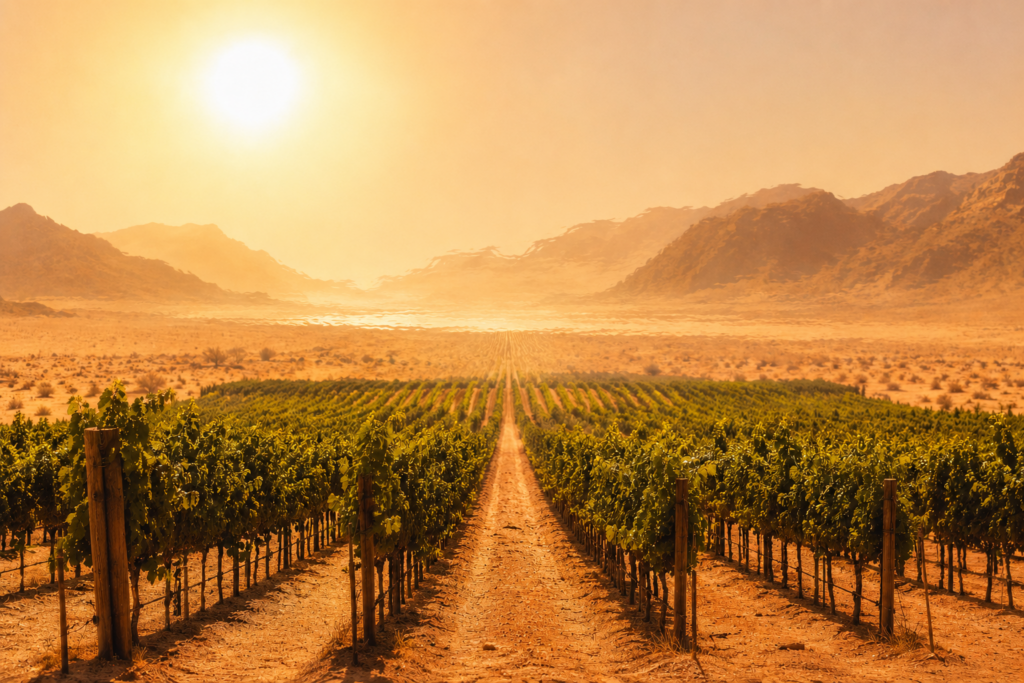
Tasting Bordeaux’s 2025 vintage in April offered us a sharp reminder both of current climatic extremes, and the region’s deft ability to handle them (at least at the very top end). A dry winter, early spring warmth, intense summer heat (up to 44 degrees Celsius), and late rains combined to produce varied results. Those estates with the technical means and knowhow to handle 2025 have triumphed. Many that don’t have produced wines that show it. This is not an isolated event. It is part of a pattern that, projected forwards, points toward a fundamental shift in availability of wines from traditional terroirs, and perhaps further supply from elsewhere filling the gaps.
The Map Moves North
So, where might this trajectory lead us? By 2046, the global wine map could look meaningfully different. Warming southern regions – once the heart of fine wine production – will have become too warm to deliver elegance and freshness with consistency. Time will push viticulture’s centre of gravity northward. Cooler regions – some not yet taken seriously – will become the new frontier. It is not impossible to imagine a generation of Scandinavian producers crafting Pinot Noirs. But let’s not forget a key component of vinous identity: terroir. What is unclear today is whether the crucial combination of soil and skies, unique to today’s Grands Crus, will be replicable elsewhere.
At the same time, those who anticipated this shift early will be opening the last, classic examples from all of today’s favourite regions and producers. At the dinner table in 2046, what will matter are wines of the past, preserved for the future: a Latour 2016, a Vega Sicilia Único 2011, a Masseto 2021 – perhaps alongside something new from a region we haven’t heard of in 2026.
Adapt to Survive
Winemakers have never waited passively for conditions to stabilise. They have grafted, replanted, relocated, and evolved – through phylloxera, through two world wars, through every shift the climate has thrown at them. Today, the tools available are more sophisticated than ever. The science is accelerating. In time, winemakers from one generation to the next will find ways to make sure wine production persists. But no amount of technology can recreate a specific harvest from a specific place in a specific decade. Those wines exist once. They ageslowly, quietly, and irreversibly – and in twenty years, they will carry within them something no future vintage can replicate.
The wisest move, as ever, is to think ahead.