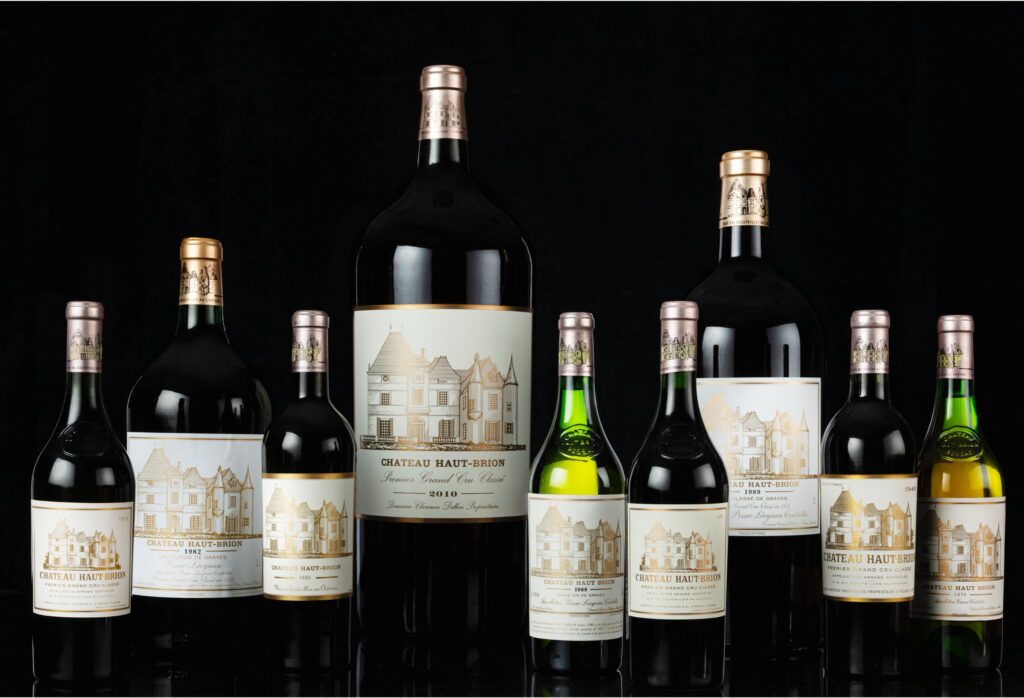
On 1 October, Sotheby’s closed a sale of wines offered straight from the cellars of Château Haut-Brion, in the family’s tenth decade of stewardship. Sales like this are rare, and they offer something the market seldom does: a direct comparison between wines whose history is beyond question and the same wines whose history has to be taken on trust.
Though a narrow dataset, the auction results back a conviction at the heart of every 1275 collection, and one we are rarely able to measure so cleanly: provenance pays. Below we expand on the results set against every comparable Haut-Brion red Sotheby’s has sold over the past twelve months, and why this matters for anyone building a fine wine collection today.
Same wine, different price
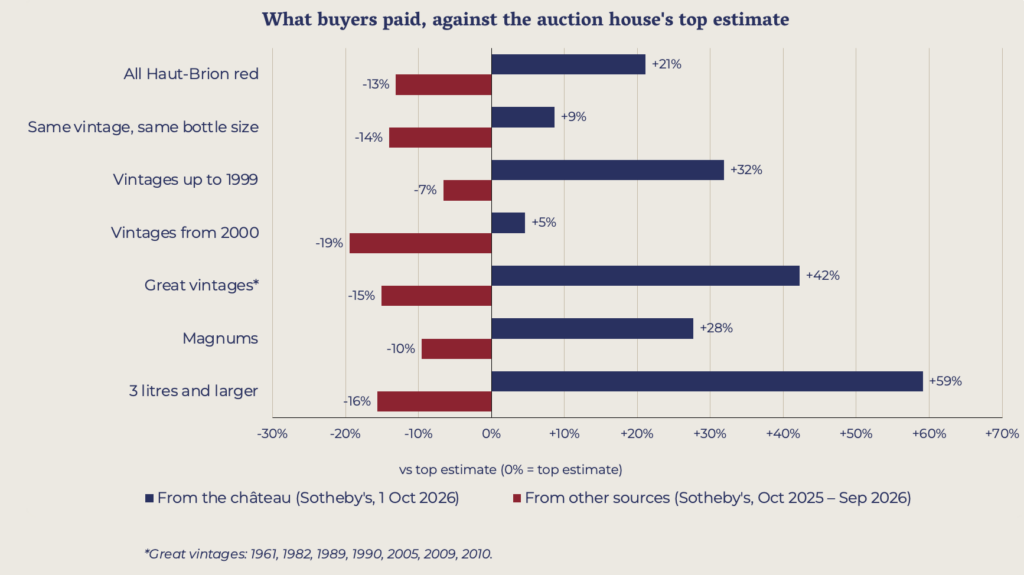
Haut-Brion red from the château’s own cellar sold on average 21% above Sotheby’s top estimate, while the same wine from other sources sold 13% below it. Comparing only identical vintages and bottle sizes featured across auctions, this gap holds: 9% above, against 14% below. At the extreme end, a 1989 double magnum (three litres) reached €45,000 against a top estimate of €10,000, and a five-litre bottle of the same vintage €62,500 against €22,000 – a new auction record for the wine in that size.
Nearly every red found a buyer in both groups, proving the power of Haut-Brion’s brand, even in a stagnant market. The major differentiator deciding price was the bottles’ history.
Paying to close a question
The premium was widest for the oldest vintages, the greatest years and the largest bottles: the wines with the longest lives behind them, and so the most years to take on trust. Buyers were not just paying for better wine; they were paying to remove doubt on the most precious bottles. A collector who intends to hold, or to hand a cellar on, inherits a bottle’s past along with the vessel itself. A doubt is not a small discount today, but a question someone else will ask later.
A race to the top
The timing of these results makes them all the more telling. The sale set several auction records while the wider fine wine market is still in recovery, with secondary market prices near eight-year lows. Buyers who can afford to be selective will be, especially for the rarest bottles. Wines with no trace of where they have been are caught in a race to the bottom, competing on price alone. Wines with perfect provenance are in the opposite race, to the top.
It’s worth addressing one caveat, that this anniversary sale with the château’s name above it would have attracted arguably more press (and therefore demand) than an “ordinary” sale. However, within this auction the whites, second wines, and experiences all sold below their top estimates – no one is immune to macroeconomic distractions, but the success of flagship wines in the sale is a sufficiently clear sign of direction for wines with perfect provenance, provided selection is sound.
An exit never taken
We do not build collections to sell them. They are built to be opened, shared and handed on. But a collection for the future should be built with optionality. For legacy collections especially, a credible exit is not optional: circumstances change, and the next generation’s tastes may not match the first. Resale is a contingency, never the plan – but should it ever be needed, it should happen on the best possible terms.
Those terms are set on the day a wine is bought. Choosing the right wines, vintages, and bottle sizes is only half the work. Only proof of provenance is guaranteed to defy market cycles. This is why we buy directly from the source, keep every bottle in our wine vault inside the Geneva Freeport until the day it’s consumed, and record every move it makes on its way in, and while it lies in wait.
The market will always find a price for a label. It saves its premium for certainty.