Mid-June, markets were watching the G7 for signals on rates, trade, and what comes next. Far in the background, the Bordeaux 2025 En Primeur campaign drew quietly to a close. What was once a major annual industry event has become something the fine wine world marks simply out of habit. Ten years ago, most Bordeaux Crus Classés would sell out En Primeur within a few days of release. Today, the number of successful releases is minimal – in our view, fewer than ten – reason enough, alongside the genuine merit of a small handful of this year’s offers, to share our post-mortem analysis below.
The Theory
En Primeur is, at heart, designed as a futures contract. Each spring, châteaux release the previous year’s vintage while it still rests in barrel – eighteen months from bottling, two to three years from the cellar. The golden rule was always simple: buy early at the lowest price you will ever see, before the bottles appreciate on release and beyond. The châteaux get cash flow; the collector gets first access and the best entry point. That rule held for many years. It has not held for the last ten.
When wines bought En Primeur reappear in bottle at the same price, or less, the argument for purchase collapses. For the majority of châteaux who continue to price against the market, En Primeur is a losing system – one we would be surprised to see survive beyond the next decade in its present form. There is also a structural reality plaguing the mid-tier: Bordeaux produces an enormous volume of wine every year. Outside the very top end, that wine is simply not being consumed at the same rate it is being produced. Supply is comfortable; demand is shrinking. This is why only the finest wines – the smallest productions and/or the most sought-after names – retain any real pricing power. The sweet spot is narrow: high quality, limited volume, and a release price that acknowledges reality. The one lever left to the châteaux is price – and this year, mercifully, some of them pulled it.
2025
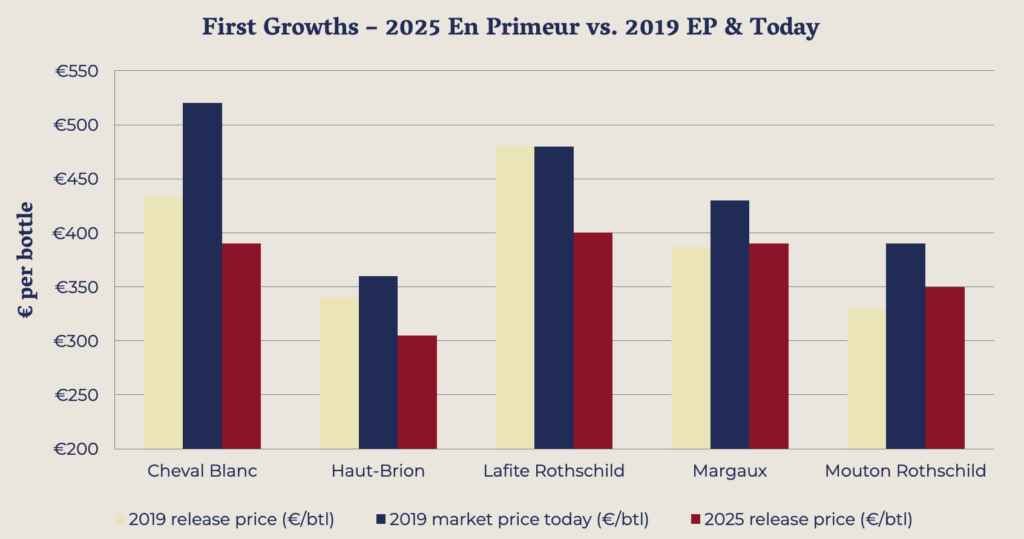
The vintage itself deserves attention. 2025 sits comfortably among the finest years of the past decade – alongside 2016, 2019, and 2022 – and in uncharacteristically small volumes. The benchmark we naturally return to is 2019: not only for its quality, but also for its release context. That was the last campaign that actually worked – when châteaux, facing a frozen, Covid-ridden market, cut prices meaningfully. Collectors responded, and the wines went on to grow in value, because room was left for prices to do so. 2025 has the same shape. At the top end, releases came in meaningfully below where 2019 can be found on the market today (see figure below). That is the comparison that matters – not year-on-year campaign arithmetic, but whether the entry point is genuinely below where comparable physical wine already trades.
Our Approach
We are not habitual En Primeur buyers. Our default position has been to watch campaigns from the sidelines and acquire the same wines in bottle, later, for similar prices – a calculation that saves cash when factoring in the cost of carry. This year we departed from that – deliberately, and selectively. Attention was elsewhere, allocations were available, and at the top estates, prices finally shifted to a level we could back. This, in our reading, is the floor. We do not believe these wines will be found materially cheaper. This is a moment where En Primeur is serving its purpose again.
What Now?
None of this means the broader picture has changed. Bordeaux remains, broadly, in crisis – which is precisely why selective opportunities exist within it. 2025 is one of them: a clean way into the first growths at what we believe to be their near-term floor. Alongside this, our preference remains for buying back as much time as possible – acquiring wines with age and perfect provenance, in which we see genuine intrinsic value and a disappearing supply. Providing the selection is done soundly, these are the wines that will always prove their worth in the long-term.