
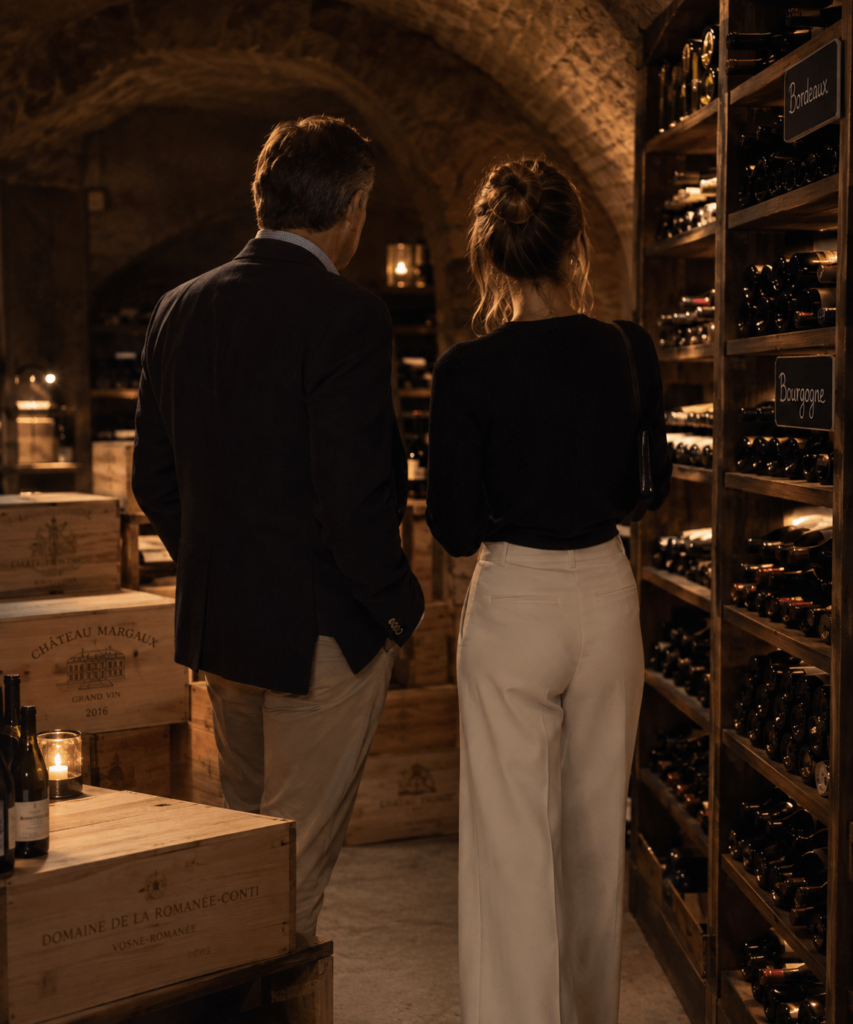
We often write about building collections, about passing them down the generations. We write far less about those who inherit them, and less still about the long middle: the years when great wines can simply be part of the household. This is where meaning is created, and where the true worth of a legacy collection shines the brightest. Perhaps some of what looks like a generation drinking less is really a generation that never embraced conviviality around a table. Wine is not about alcohol, but about what happens around it.
The burden is not the wine
Some might worry that a collection built for a child when he or she grows up could end up a burden. In the case of a few birth year bottles stored at home that unfortunately don’t survive into their recipient’s adulthood, this would be correct. But a collection that is curated, fully traced, defensible and built with optionality is far from burdensome.
At this level, avoiding the burden is a low bar. The more interesting question is what happens in the decades before anything is handed down at all.
The years in between
Legacy planning can result in thinking too much about a beginning and an end, when in fact the journey in the middle is the important part. One of the best things children can inherit is a family tradition. A collection that is only ever an asset stays in the dark, and nobody grows up around it. One that is lived with behaves differently: a case put aside at a birth and opened at a coming of age, the wine a grandfather always poured at Christmas, and which someone else now keeps pouring. Over the years a family builds its own references, and habits pass down far more reliably than taste.
It is why we build legacy collections on two horizons: wines for the upcoming years, and wines still climbing when the next generation establishes its own traditions for breaking bread. A cellar of only great and distant vintages is a museum. One with both is alive.
What is handed down with it
There is a second inheritance, subtler than the wine, and the one more likely to go missing. In most private cellars the knowledge lives with the person who built it: where each case came from, what was paid, why this producer and not that one, which bottles are for keeping and which are for a Tuesday. It is almost never written down, because a collector has never needed to write it down. Yet it is the part that makes a collection relevant to someone who was not there for any of it. Wine handed down without it is a set of objects. Handed down with it, it becomes a way in – a map of one person’s taste, which the next person is free to follow, argue with, or extend.
At 1275 we are custodians of great wines, but we are also custodians of this continuity: of the thread that runs from the estate, through the quiet years in the Geneva Freeport, to whoever eventually pours it. Anyone who grows up immersed in the culture of “art de la table” rarely needs persuading of the rest.