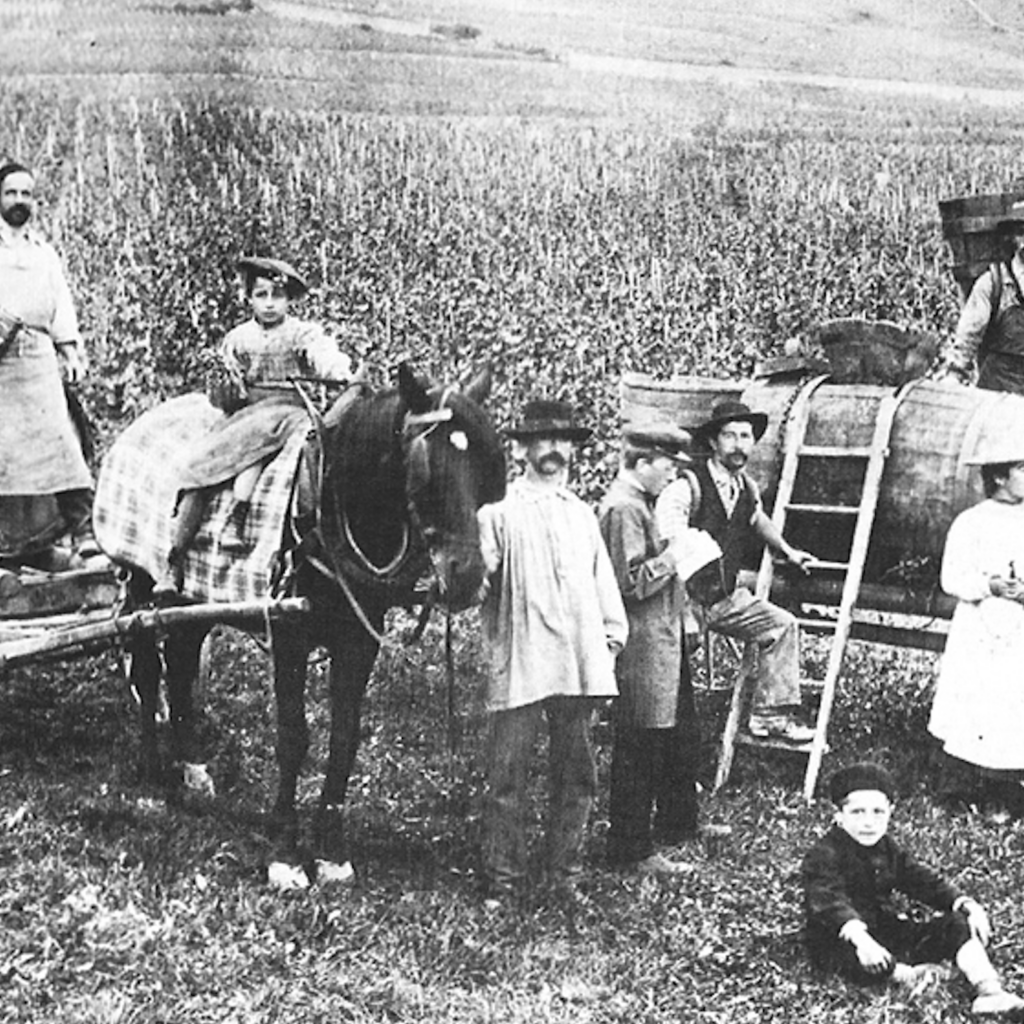
Somewhere in the archives of Beaune sits one of the most remarkable records in Europe: a complete ledger of harvest start dates for almost every year since 1354. Of course, these entries did not begin with climate change in mind. They reflect the ban des vendanges – the official proclamation of the start of harvest – what they paid their pickers, and later, newspaper reports of the first cutting of bunches. Little did the town clerks of Burgundy know that, over the centuries, they were creating one of the longest continuous climate records in existence.
A ledger written in grapes
Grapes ripen with warmth, so a warm year tends to bring an early harvest, and a cool one a late harvest. Read the dates in sequence and you are reading Burgundy’s weather, summer by summer, through plague, wars, revolutions and the arrival of the railway.
The ledger also tells us that heat is nothing new. In 1556, picking in Beaune began on 16 August, three days earlier than in the scorching summer of 2003. Across the 1540s and 1550s, harvests began on average in mid-September, much as they did between 1990 and 2009.
What has changed is the rhythm. From 1354 to 1987, harvest around Beaune began, on average, at the end of September. Since 1988, it has begun an average of two weeks earlier. Hot years – once rare exceptions – now follow one another. Over the last decade, a late-August picking start has become the norm. In 2026, Chardonnay picking in Le Montrachet began on 13 August; reportedly the earliest still-wine harvest on record in Burgundy.
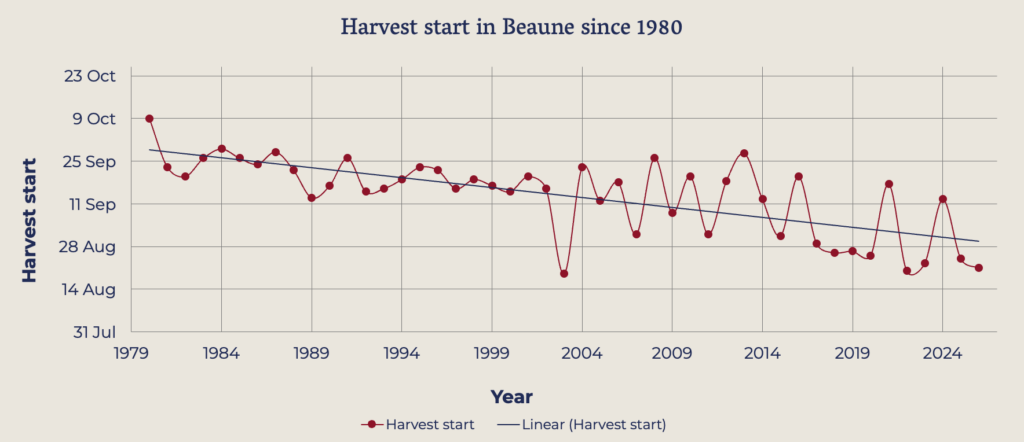
*Start of harvest in Beaune, 1980–2026. Sources: 1980–2010, Labbé & Gaveau, Revue historique (2013); 2011–2026, indicative dates compiled from press reports.
Reading between the rows
It would be easy to read this as a story of decline. But we read it as a story of resilience and adaptation. Burgundy’s growers have spent centuries reading their vines, and they are reading them still: picking in the cool of the night, rethinking canopy and vine selection, and adjusting the calendar to the fruit rather than the other way round. Some of the region’s most celebrated recent vintages were born of exactly this attentiveness. The ledger is not a lament. It is evidence of a culture that observes, records and adapts.
But adaptation has its limits, and the climate is changing. Growers can pick earlier, shade their fruit and move up the slope for a while, but in time warming will redraw the map of fine wine. Some Burgundians are already looking to cooler places: as far afield as Oregon, and closer to home in the Jura, and even parts of Switzerland.
Every bottle a page
Each bottle is its own entry in the ledger: one year’s sun and rain, one harvest date, sealed under cork. A cellar built over decades becomes a private archive of a changing world, and of the people who learned to read it.
Beaune’s record matters because it was kept faithfully for nearly seven centuries. We hold every bottle to the same standard, tracing it from the domain to the Geneva Freeport, so that its story is told in full. In years to come, when, as a friend put it recently, “Pinot Noir from Burgundy feels more like Syrah”, we will have preserved a perfect record of how “real Burgundy” used to taste.