

Wine lovers are living in lucky times. Wine quality has never been better, and production is plentiful. So much so in fact, that – according to recent press coverage reporting on the global wine surplus and reduction in alcohol consumption – we’re in an era of wine-glut. But is there really too much wine? The answer of deluge or drought depends on quite how well one is drinking, see below.
Supply
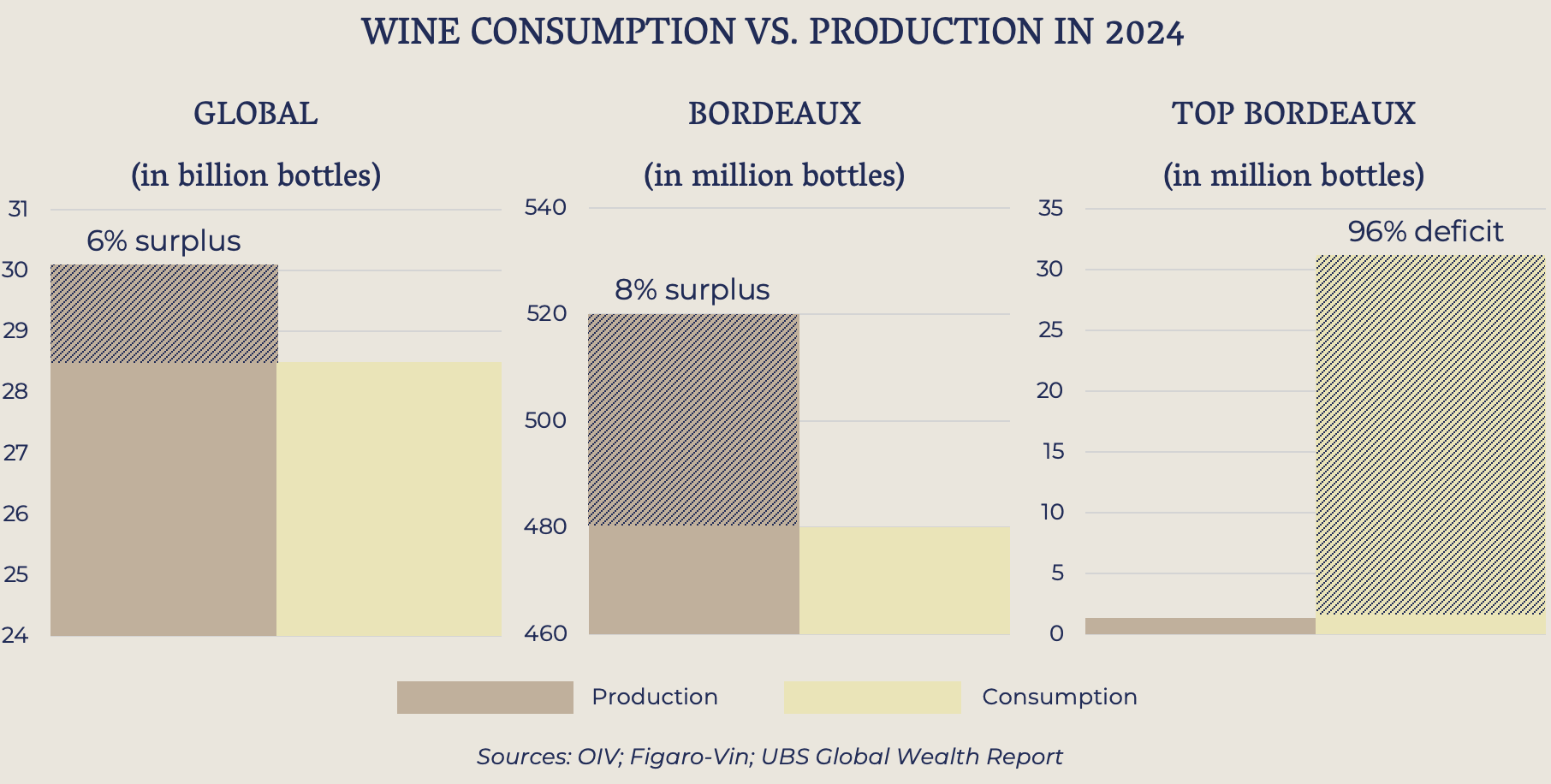
In 2024, roughly 28.5 billion corks were popped (or caps unscrewed) around the globe, while the same vintage – a historically low production year – yielded 31 billion bottles. This equates to a global production surplus of 6%. Bordeaux’s imbalance is greater – production exceeds consumption by more than 8%, explaining the recent government schemes that (tragically) incentivise growers in satellite appellations to grub up their vines, in favour of more profitable crop. It is nonetheless critical to specify that these numbers concern ALL wines. The picture of top Bordeaux, namely the 1ers Crus Classés and their Right Bank equivalents, is rather different.
Demand
While global wine consumption is declining, this decline is enormously biased towards mid- to low-level wines. Consumers are drinking less, but better. Premiumisation, greater education, environmental awareness, and a focus on provenance are reshaping demand. This polarises effects – lesser demand towards the lower end, and increasing competition for the most desirable wines. Using the top 10 Bordeaux estates as an illustrative example, the wine-glut theory can be thrown out. A total production of roughly 1.3 million bottles exists to serve the appetite for Bordeaux of all HNWIs, resulting in a structural deficit of nearly 96%*.
The Real Imbalance
So, is there really too much wine? While mass- to mid-level segments see a small surplus today, vinous legends are still far more sought-after than initial numbers serve to illustrate. What’s more, the constant pursuit of finer quality alongside the impact of climate change will only reduce production of these icons in the long-term.
With limited volumes and resilient demand, our belief in Bordeaux’s greatest needs no further explanation.
*22 million HNWIs consume a conservative estimate of 3.5L per capita per annum, totalling 77 million litres. Assuming 30% is Bordeaux, this equals 23.1 million litres (or 30.8 million bottles) of Bordeaux consumed globally by HNWIs each year.