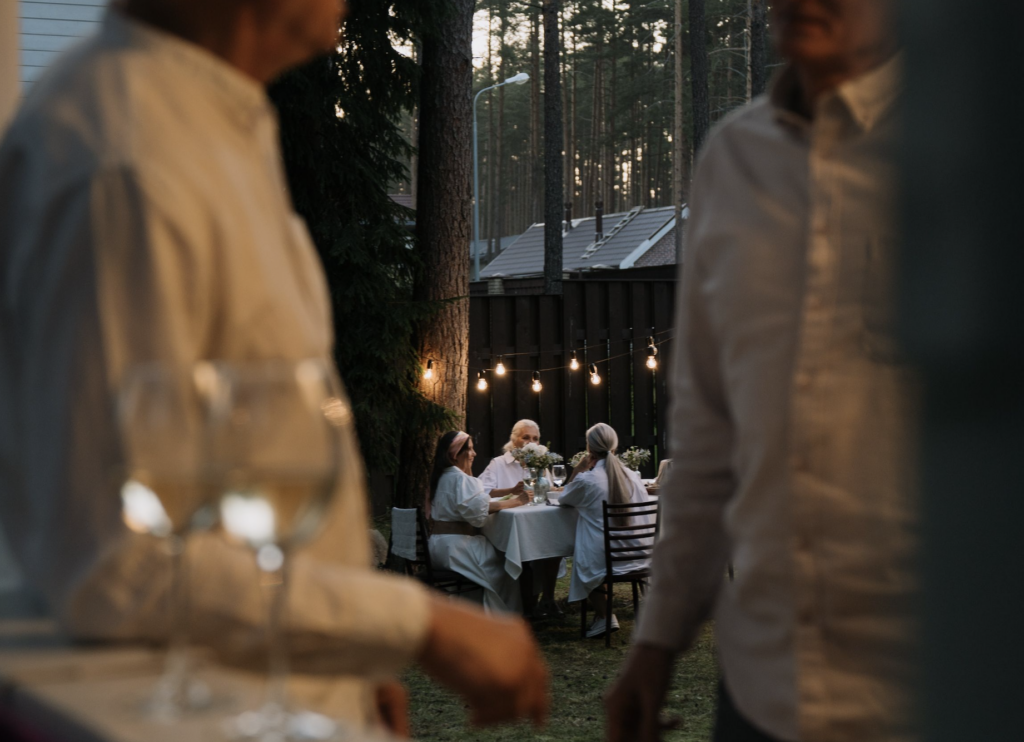
This week, the 1275 team gathered in Geneva for our summer party. Meanwhile, SpaceX prepped its IPO launch, and Donald Trump claimed an end to the war for the hundredth time. The world was doing what it tends to do: moving fast – for better or for worse – while we took time out sharing Italian plates, opening imperials, and letting the conversation go wherever it pleased.
It might feel indulgent, in those moments, to spend an evening on lighter things. But perhaps it shouldn’t. Humanity has always relied on exactly these gatherings – a table, a bottle, the kind of conversation that goes nowhere useful and everywhere important. Wine has been part of that fabric for ten thousand years, not as an accessory to civilisation, but as one of its mechanisms. In this environment, large formats could be perceived as tactless, but we reach for them purposefully based on the underlying statement they make. Some bottles are parked for years, even decades, for evenings just like these, where a gentle celebration of humanity is exactly what we’re all craving.
Optimisation
A few weeks ago, Steven Bartlett – entrepreneur, Dragons’ Den investor and podcast host – told his millions of followers that two glasses of wine had ruined not just his morning, but his life. Three lost days, and the wearable on his wrist had the data to prove it.
We understand the impulse. The language of optimisation has become the vocabulary of everyday life – sleep scores, workouts tracking, cold plunges, productivity systems. For people building serious things, the pursuit of longevity and peak performance is sincere, not merely aesthetic. Discipline in one’s work and care for one’s health are genuinely good things. We are the first to applaud and apply them when necessary.
Returns
But somewhere along the way, people like Bartlett appear to have forgotten what it means to live well.
The point of working hard, of guarding your health, of being productive, is surely to earn the time for things that have no productive purpose whatsoever. An evening with old friends is not an input to be optimised. It produces nothing a device can record: not the conversation that resumed exactly where it left off last year, not the second glass of Ponsot’s Meursault 2019 or Montrose 2000 poured a little too generously, not the reason anyone bothered to come at all.
These are the returns that don’t show up on any dashboard – and, not coincidentally, the ones that compound the most over a lifetime.
Purpose
We believe wholly in the necessity of this balance. Work hard, by all means; optimise where it serves you. But protect the hours that are meant for indulgence, and resist the urge to manage them too. A great bottle, shared slowly with people you appreciate, asks only that you be fully present – a phenomenon we’d argue is becoming the rarest luxury of all.
This is, in the end, the true purpose of the collections 1275 builds. Not for a number on a screen, but for the evenings those bottles are destined to become – the weddings, the reunions, the unhurried summer nights years from now. We look after these wines so that, when the moment comes, the only thing left to do is open them.
Some of the best things in life are entirely unmeasured. Long may they stay that way.