

Musings on Burgundy are rare at 1275. The region’s ascent into a speculative playground over the past 5-10 years has pushed some wine prices to levels that strain credulity. Among some of the modern celebrated names are producers who, in our view, are unlikely to reward the patience that long-term cellaring demands. We have watched the market with some scepticism, and kept our counsel, aside from a few key partners in whom we have full confidence.
There is nonetheless a corner of Burgundy that merits wide attention, both from a consumption perspective, and offering a masterclass in clean supply-demand dynamics – its whites.
No Substitute
White Burgundy occupies a position in the fine wine world that no other region has managed to replicate. The best chardonnays of the Côte de Beaune – mineral yet rich, floral yet concentrated, are architecturally precise, and simply unlike anything produced elsewhere. Top Californian producers do a stellar imitation job, albeit for wines of comparable price and often different structure. A handful of legendary Italian producers make increasingly compelling whites (Ornellaia Bianco, Nibbio, and Gaja’s Gaia & Rey to name a few). But in honest terms, quantities remain anecdotal at the level where real quality emerges. For now, white Burgundy stands alone.
Five Vintages, One Lesson
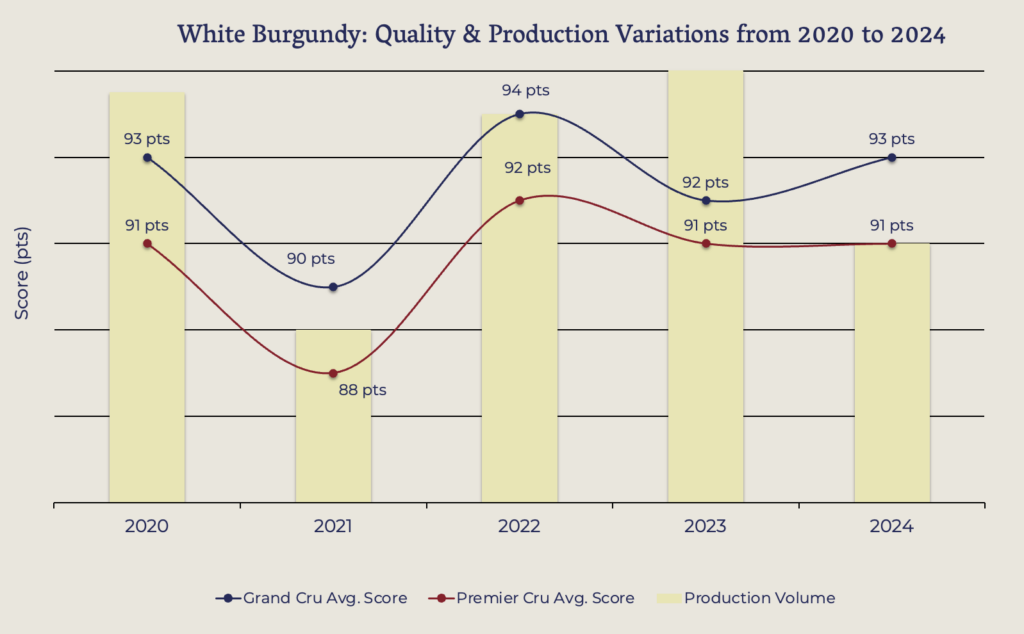
*The chart compares white Burgundy production volumes with average Grand Cru and Premier Cru quality scores from 2020 to 2024 – based on Vinous, the BIVB & Liv-ex Burgundy Market Report 2026.
The chart above tells a story that anyone following the region will recognise. Across Grand Cru and Premier Cru sites, quality has remained consistently high – the score range over the last five vintages is narrow. What has varied dramatically is quantity. The 2021 vintage, devastated by frost, yielded barely half a normal harvest in some appellations. The 2024, shaped by relentless rain and mildew, saw yields down roughly 25% in 2023, with Chablis particularly hard hit. Two of the five most recent vintages have arrived in painfully small volumes. Quality has held; supply has not.
The Sweet Middle
At the very top of the pyramid – icons such as Coche-Dury or Leflaive – the market has reached a point of genuine hesitation. Even committed collectors are beginning to impose a price ceiling on ageworthy white wines – a phenomenon that has struck its red counterparts with less force. This is not a market we feel compelled to chase. White Burgundy is perhaps the one category where 1275 actively recommends the middle ground. Premiers Crus from the likes of Ramonet or Etienne Sauzet are not “compromise choices”. They are, in our view, the most intelligent ones.
Ahead of the Game
There is a practical argument for acting with some urgency when it comes to white Burgundy. As the default white choice on every serious restaurant wine list, these bottles are opened, and therefore rarify, at an impressive pace. Stock of aged whites is therefore increasingly difficult to find. Anyone who has tasted a properly-aged Meursault or Chassagne at ten years old understands immediately why this matters. The structural case for owning whites with age is unusually strong. With supply narrowing vintage by vintage, those who act with carte blanche now will be the ones pouring with pleasure in a decade’s time.