
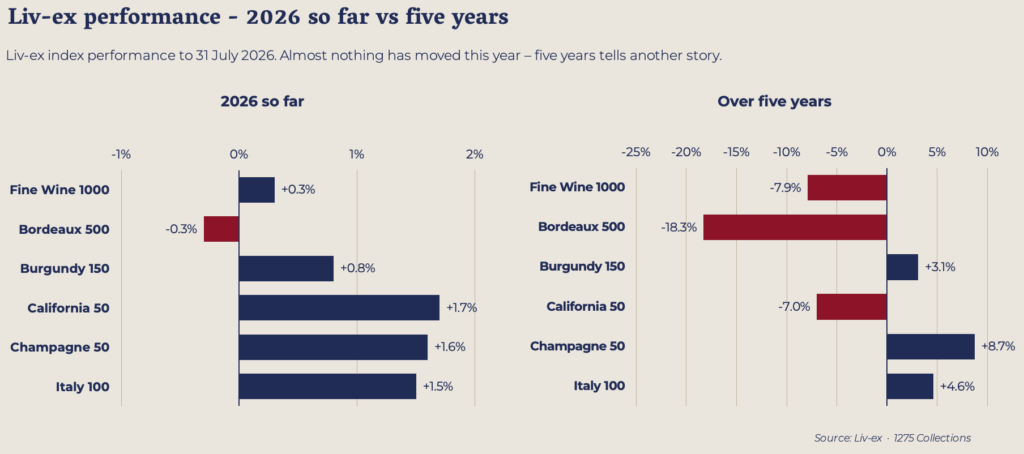
Eight months into 2026, the Liv-ex Fine Wine indexes have barely moved from where they began the year. Stillness is hard for a market analyst to read. Prices falling or rising carry a clear story; prices that refuse to move tell almost nothing, until you look closely at what is moving underneath them.
Three things stand out from our studious summer of market monitoring:
- America and China are slowly returning to the table, and trading activity is picking up modestly. Liv-ex reported a fifteen-month high in number of trades this summer.
- Ultra-rare stocks are finding homes faster and at higher prices, yet the bulk mid-tier is still losing ground – the flat headline hides a tale of two halves.
- Fine wine is living in the limbo of its new floor, and persistent interest rates are reducing a potential tailwind into a gentle breeze.
Predictions confirmed
In our Q1 Market Watch we backed the middle of three paths and made one claim: that concessions from elite estates would centre on access rather than price throughout 2026. That is precisely what has been happening so far, and we’ve been putting it to work – boosting some of our collections with top-tier wines at prime maturity. Think great Bordeaux from 1982, 1989 and 1996, or Burgundies from 2018, 2019 and 2022.
Gaps worth exploiting
The opportunity is time-sensitive, as fortunes of cash-strapped estates lag behind a secondary market in early-stage recovery. If prices have begun to rise on the market at large, our access to selective parcels directly from estates (who are still caught under the price freeze of the past two years) has been a clear point of arbitrage.
Prime examples are where short-term oversupply masks mid-term shortage: ten-year-old top-tier Bordeaux is one, as the region’s own supply is shrinking and the next three consecutive vintages (2024, 2025 and, on all current evidence, 2026) will be small. White Burgundy is an other example with tiny crops in 2024 and 2026, and wines that tend to be opened early rather than cellared.
A summer of reckoning
Prices have plateaued at multi-year lows, including for some of the finest vintages ever made. In the meantime, most great wine regions had their own reckoning with climate change this summer. In Bordeaux, 42,000 hectares of the Gironde burned – the largest fire in the region since 1949. In Burgundy, the defining problem was heat and drought, leading to the earliest harvest on record, and growers in Chablis reportedly expecting 13 to 15% natural alcohol. Champagne started their harvest in early August, which is unprecedented, and Piedmont just suffered intense hail storms. All these regions will face drastically reduced volumes in years to come.
Whatever the macro path, these mechanics are hard to argue with over the long term. So here are our three scenarios – for the optimists, the pessimists and the realists.
- Bullish: The floor holds, the American and Asian bids rebuild, and prices raise again. With supply visibly tightening, wines still trading below their original release price will clear first and fast.
- Conservative: Rates stay higher for longer and a recession arrives. The mid-market collapses, the top-end falters briefly, and aggressively low bids become the only thing defining a thin tape.
- Middle ground: The past eight months simply continue. Estates concede access rather than price, the top-tier solidifies while the mid-market keeps clearing, and returns come not from the market rising but from buying below where it already sits: a negotiator’s market.
Our call for the fourth quarter
The realistic middle ground. Both alternatives imply big assumptions that are not yet reality: the bullish case requires international wine appetite to be fully restored, and the conservative case, a global recession.
Eight flat months are not an absence of information – they indicate that the market has found its floor. That makes the fourth quarter a matter of execution rather than forecasting. Three buying strategies will keep us busy in the weeks ahead: (i) closing the arbitrage before estate pricing catches up with the secondary market (ii) concentrating on the abovementioned themes – ten-year-old top-tier Bordeaux, white Burgundy, but also iconic Champagne and Piedmont (iii) taking concessions as access rather than discount, while the elite estates are still willing to give.
None of it depends on the market rising. As guardians of a precious legacy, preserving iconic wines today inside the Geneva Freeport with unbroken provenance remains our mission, ahead of an uncertain tomorrow.