
This week marks the beginning of a new lunar year – the Year of the Horse. Traditionally associated with energy, independence, and success through action, it invites reflection on what drives us to act – and specifically, the information on which we rely to make decisions. We believe that wine is, above all, an asset of instinct: a passion for exceptional experiences through great bottles opened, as opposed to a commodity viewed through spreadsheets or algorithms. That being said, having eyes on the numbers, and understanding their implications provides valuable reassurance for any investor wishing to move forward unblinkered.
Price
Regular readers will recognise our references to Liv-ex, the industry’s benchmark index for fine wine pricing. Below is a short guide to demystify some of the key numbers you might see quoted.
Q: What is the Liv-ex Market price?
A: It represents the lowest tradable secondary-market price for a given wine, drawn from Liv-ex’s global database of merchants, retailers, brokers, and other trade participants. This reflects the realistic asking level at which the wine is able to find buyers.
Q: What is the Liv-ex Average price?
A: A quantity-weighted mean of all merchant list prices (within 30 days). This provides the broader advertised price landscape, capturing offer variation by geography, seller type, and stock conditions.
Q: What do these numbers tell us?
A: For wines with low liquidity (i.e. infrequent trades), these numbers become less meaningful in isolation. However, the spread between Market and Average prices can offer insights:
- Low spread: A tight market, with clean pricing aligned between distributors, and with demand.
- High spread, young vintages: Reflects a price-discovery gap, often a sign of ambitious release pricing and/or an illiquid market phase (with wide availability).
- High spread, older vintages: Thin availability, and price dispersion driven primarily by large variations in provenance.
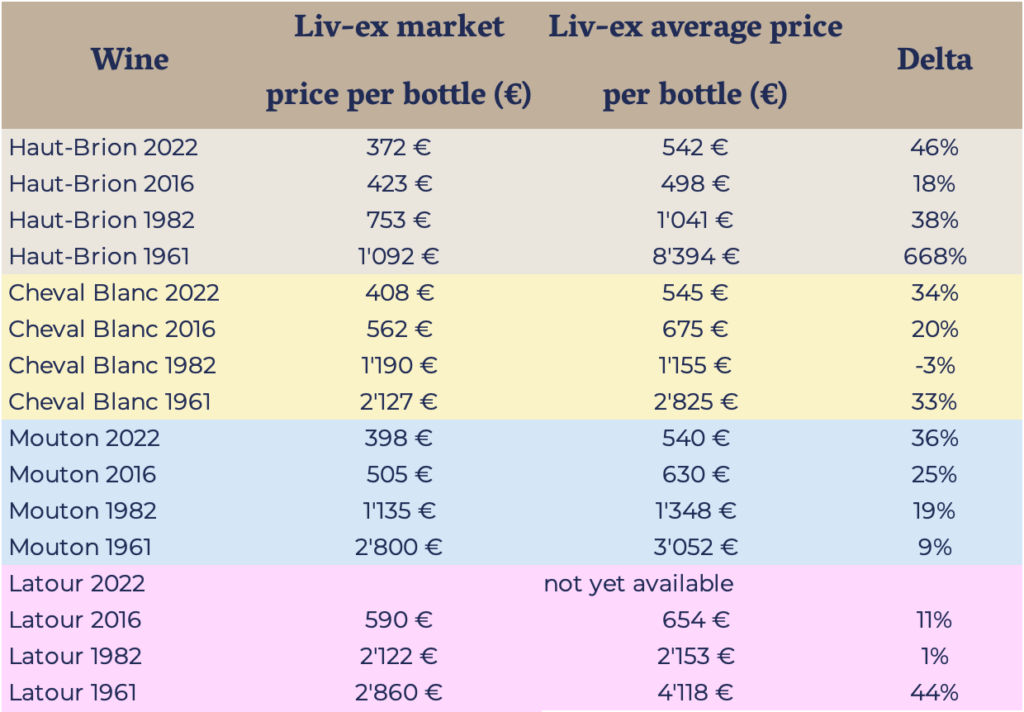
The table above compares Liv-ex Market and Liv-ex Average prices per bottle for selected Bordeaux wines and vintages, highlighting the market spread, as represented by the Delta between prices. Data sourced w/b 16.02.26.
Precautions
Fine wine remains a small and fragmented market, and numbers must be interpreted with caution – particularly the Liv-ex Market price. Prices can move sharply in short periods. A real example occurred this week with Haut-Brion 1961: its Market price appeared to drop 56% in five days. The cause? A single anomalous trade (likely of a heavily bin-soiled bottle). In practice, owners of Haut-Brion 1961 with impeccable provenance can rest easy: in spite of the numbers, the wine’s intrinsic value and long-term desirability remain unchanged.
Peace of mind
For fine wine, data should be used as a tool for peace of mind, but not as the sole driver of decision-making. As with any thoughtful investment, instinct has its place – especially for an asset whose future value is shaped by the preferences and behaviour of future drinkers. At 1275, we use Liv-ex numbers to verify our own market intelligence: sometimes confirming, sometimes challenging our instincts. While investing in fine wine is ultimately more art than science, once the wine selection is sound, the safest horse to back is time.