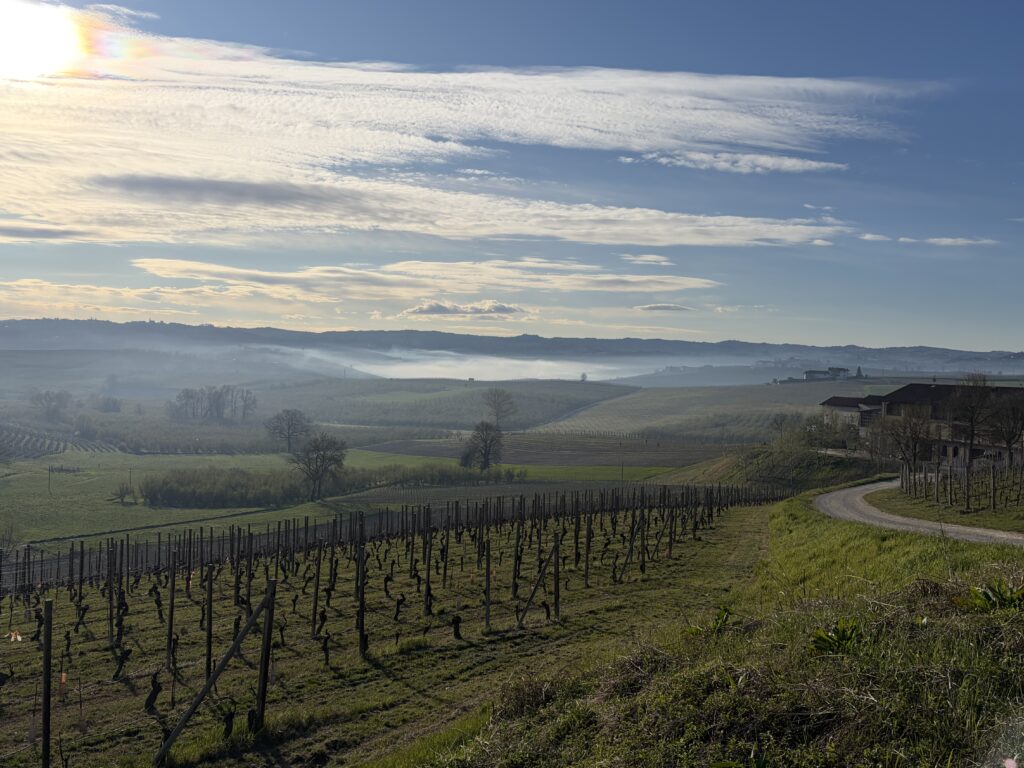
Members of the 1275 team spent a few days in Piedmont before Easter, visiting producer friends. The trip served as a reminder of the region’s remarkable potential. Even in challenging vintages, its wines show precision, elegance, and ageing capacity – qualities that position Piedmont’s top producers as contenders for long-term spots in fine wine’s hall of fame. With this in mind, we share below a snapshot of our takeaways from Nebbiolo-land.
Variations
Piedmont, like many great regions, has faced its share of challenges over the years. Difficult vintages have tested patience and precision, reminding us that great wine is never guaranteed. And yet, this is precisely where the region reveals its character. Alongside these more complicated years, truly remarkable vintages have emerged – 2016, 2019, 2021, and, from early indications, 2025 – each marked by clarity, structure, and great balance.
What becomes clear is that variation is not a flaw to be managed, but a defining feature to be embraced. It is through contrast that Piedmont expresses itself most honestly.
Interplay
Piedmont is often cited as Italy’s Burgundy, and the comparison extends far beyond stylistic parallels. It lies in the region’s relationship with time. Great vintages demand patience; they are built to evolve slowly, revealing their complexity over years, sometimes decades. Others are more immediate, and invite earlier enjoyment without compromising their integrity. During one of our visits, a producer expressed this idea with striking simplicity: “we needed a difficult 2024 to make a fantastic 2025.” A rainy, challenging year restored balance to the soils, allowing the following vintage to reach greater harmony. As the saying goes, only after the rain can one expect a rainbow.
This notion of co-dependency between vintages reflects a deeper equilibrium – one that resists the pursuit of consistency at all costs, and instead embraces the natural cadence of the land. Even the decision to produce a Riserva* for Barolo or Barbaresco follows this logic: they exist only when the conditions and quality truly justify them. In the same spirit, the greatest vintages often require time – sometimes decades – before they fully reveal their potential. In the meantime, more approachable vintages play an essential role. They allow us to engage with the region in the present, offering immediate pleasure while the finest years continue to blossom in the cellar.
*reserved for exceptional years only, and resulting in one more year of ageing (5 years in total).
Emergence
What is perhaps most compelling about Piedmont today is the evolution underway. The region is in a phase of increasing refinement, reminiscent of Burgundy some ten years ago. Precision is growing in the vineyard and cellar, resulting not only in better wines, but in more resilient, sustainable businesses. Top producers are beginning to appreciate the strategic value of retaining a reserve of back‑vintages, as well as approaching release pricing with greater discipline (perhaps taking note of lessons learned from some of their French counterparts). Overall, we observe a well-deserved, quiet confidence brewing in Barolo.
At 1275, while we remain Bordeaux lovers at heart, our appreciation for Italian wines continues to deepen. These few days in Piedmont only reinforced this conviction. This is a region that rewards attention. Its elegance, structure, and ageing potential make it not only intellectually engaging, but a natural addition to any thoughtfully built collection. We look forward to making these additions through our new direct allocations in the coming months.