A collector we spoke with recently described how they had come to a tough realisation. For years they had bought opportunistically: a parcel at auction, a case from a merchant, a few bottles from a private cellar. Each time they saved perhaps 10-20% against the top-of-the-market price, and each time it felt like a win. Then they began opening the bottles.
The truth is binary
During our conversation they voiced the miscalculation; the opening 10-20% discount against a binary victory or loss, years after the initial purchase. Once a bottle reaches the table there is no range of results. It is either sublime, memorable, and longlasting, or it is not. Perhaps, our friend conceded, on “everyday” drinking wines, this doesn’t matter. But on wines designed to “wow” – Bordeaux First Growths, top Supertuscans, Burgundy Grands Crus – the disappointment of an imperfect bottle weighs heavily. Twenty years of anticipation resolve in seconds once the bottle is opened. Set against that, a discount at the point of purchase is a rounding error.
The arithmetic, and some good news
It is unrealistic to expect perfect provenance at no cost. We’ve tracked ex-château offer pricing on 14 leading Bordeaux estates for the last two and a half years, matching them against prices on the open market (see figure below). On younger wines, a complete provenance record costs 10-20% more. Past a decade-old, this percentage naturally climbs with age and rarity. On the mature wines we track it has run as high as 37% on average (with outliers up to 100%).
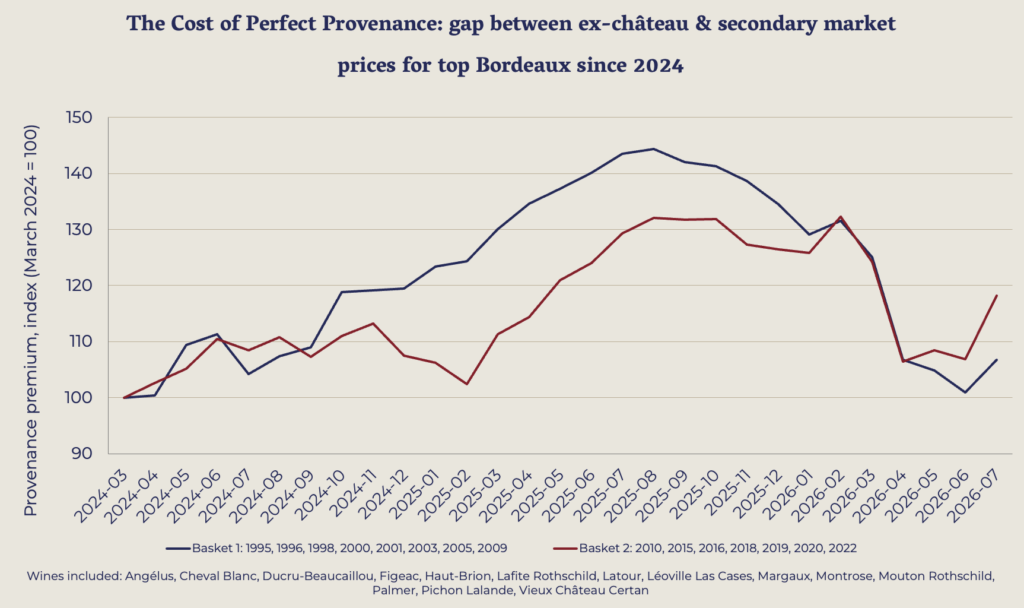
* How to read this graph: the graph above shows the evolving % gap between ex-château and secondary market prices, rebased to March 2024. Given that secondary market prices dropped in the period, read that ex-château offers remained stable, until Q1 2026 when they dropped to match the secondary market.
Here is the good news: throughout 2026, we have seen the average provenance premium reduce drastically. The drops lagged longer for the older vintage basket – 1995-2010, than for younger vintages. As the market recovers, both baskets are showing signs of return to normalcy.
What a good deal really costs
The point is not these numbers themselves, but rather the consequence of temptation. Everyone likes a good deal, but the true cost of fine wine does not stop at the invoice. It includes the years of carrying the wine until it is ready, and the anticipation that builds all the way to the moment you open it. Saving 10-20% at the start is small comfort if that moment doesn’t deliver.
At least, right now, there is a way to buy back some of that waiting. Mature bottles, in perfect condition, with absolute proof of perfect provenance, are as close to secondary market prices as they’re ever likely to get.