We talk about climate change a great deal – over dinner, in the press, at conferences. And yet, one conversation after another, we notice the same blind spot. People picture warmer summers, a few difficult vintages, perhaps a château adapting its blend. Almost no one pictures the end of the road: a world in which certain wines simply no longer exist. Not rarer. Not dearer. Gone. It is an uncomfortable thought, so it’s natural not to entertain it. This week, we dare you to.
In The Soils
The instinctive story is one of heat – grapes roasting under a fiercer sun. But heat, on its own, is a problem the finest estates have learned to manage: canopy work, later-ripening plots, higher-altitude parcels, patient replanting. Vines are Mediterranean creatures; they can take the warmth.
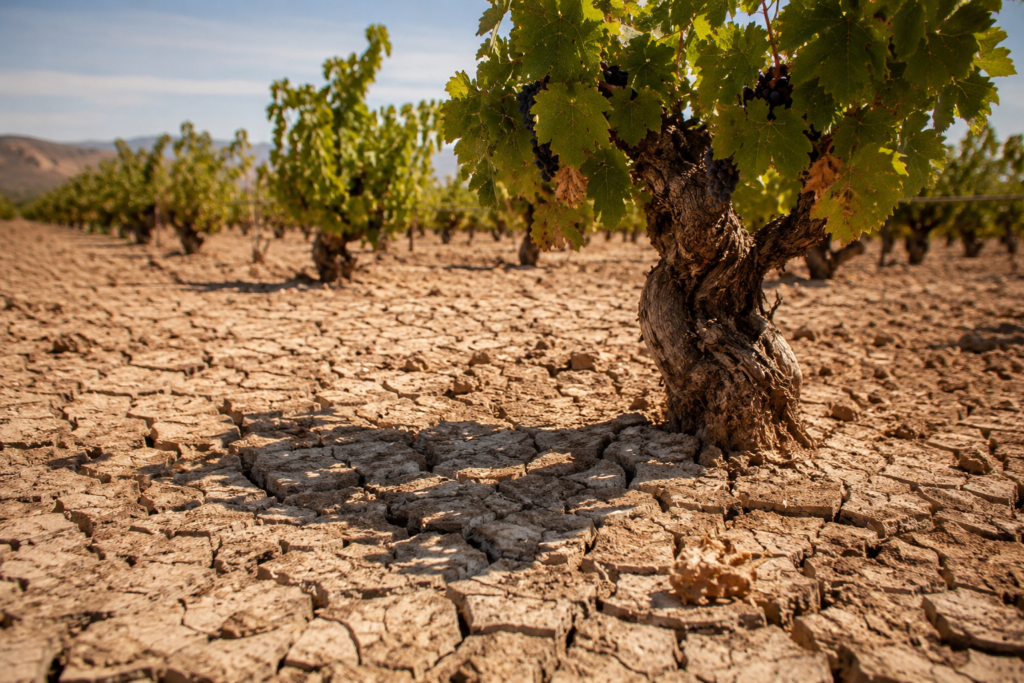
What they cannot take is thirst. The quieter, graver threat is water – or the lack of it. Drought stresses the vine before harvest and, more permanently, drains the reserves a vineyard depends on year after year. In parts of southern Europe, growers now face seasons where there is simply not enough water to bring a healthy crop to maturity. You can engineer your way around a hot afternoon. You cannot engineer rain that never falls.
Some estates are trying. Lafleur gave up its Pomerol appellation – declassifying to Vin de France – in order to carry out water-related interventions that appellation rules would otherwise forbid: water infiltration in the soils to rebuild subterranean reserves, and fine misting between the vine rows to reduce heat stress at canopy level. It is considered, intelligent work – and it may buy time for those with the means and the land to implement it. But the underlying constraint cannot be engineered away. There will not be enough water for every estate to do this. The question of which vineyards survive in their current form will, in part, be answered by hydrology.
In The Calendar
The evidence is not in some distant forecast; it is in the harvest calendar and the news cycle. Across much of Europe, pickers now go into the vines noticeably earlier than a generation ago – the growing season compressed, the rhythm of centuries rewritten within a single working life. But earlier harvests are only part of the story. What is changing just as visibly is the violence of the weather between seasons.
Wildfires, once an anomaly in fine wine country, are becoming a pattern. California lost swathes of vineyards to fire in 2020. The Gironde burned in the summer of 2022. And this week, a major fire tore through the forest above Nuits-Saint-Georges, threatening over 300 homes and the vineyard beneath. Burgundy had already taken a severe blow in June, when a hailstorm cut through the Côte de Beaune in minutes, destroying up to 80% of the crop in parts of Beaune and Pommard. Fire, hail, drought: the threats are not sequential. They arrive together, in the same growing season, on the same land.
When the fundamental clock of a region starts to shift, and its weather becomes genuinely unpredictable, it is no longer an anomaly to manage. It is a change of climate, in the most literal sense.
In The Glass
Here is the part that rarely gets said aloud. The great estates will adapt – they have the land, the capital and the knowledge to keep making beautiful wines, albeit in ever-smaller quantities. The vintages we are able to buy today, from the places we love, in the styles we recognise, are not a permanent fixture. They are a specific expression of a certain climate, and that climate is already receding.
Which is why, for us, this is not an argument for despair but for care. The scarcity climate change creates is precisely why perfect provenance matters more with each passing year: when a wine can no longer be remade, the only thing that protects it is how faithfully it has been kept. We source directly, store under optimal conditions in the Geneva Freeport, and preserve full traceability from château to cellar – not as a service feature, but because we believe the finest wines of this era are worth safeguarding for the next. Some might call this sentimental, but we’d rather look after these bottles today than explain their absence tomorrow.